Programmatically Getting the Metadata
Note
The “metadata” or “instrument response files” complement the raw waveform data, providing the information that seismologists use for data processing, including:
gains, overall sensitivity, poles, zeros and filters needed to deconvolve the data and arrive at true ground motion
latitude, longitude, elevation (which are obfuscated to ~1 km to protect users’ identities), and instrument type
any and all changes over time (since May, 2019)
To get individual instrument-response-file using python:
Make sure you have
pythoninstalled. To check if you have python properly installed, run this command in the terminal:
python --version
or
python3 --version
Note
If python is not installed yet, please refer to their official site to get the installer depending on your machine.
Install the necessary python packages:
pip install obspy matplotlib
Save the python script below into a file named
get_inst_resp_file.py.
from obspy.clients.fdsn import Client
from obspy import UTCDateTime
import argparse

def main(station_name):
  try:
    rs = Client(base_url='https://data.raspberryshake.org/')

    inv = rs.get_stations(network='AM', station=station_name, level='RESP')

    fig = inv.plot_response(0.001, station=station_name, show=False, time=UTCDateTime.now())

    # Save the instrument response plot into a PNG file
    fig.set_size_inches(12, 8)  # Set the output size
    fig.savefig(station_name + "_inst_resp_file.png", dpi=300)

    # Save the instrument response information into an XML file
    inv.write(station_name + "_inst_resp_file.xml", format="STATIONXML")

    # Print a message indicating the successful retrieval and saving of the instrument response files
    print(f"[\033[92m OK \033[0m] ", end='')
    print(f"Instrument response files for station '{station_name}' have been successfully retrieved and saved")
    print(f"- PNG plot: {station_name}_inst_resp_file.png")
    print(f"- XML metadata: {station_name}_inst_resp_file.xml")

  except Exception as e:
    # Handle any exceptions that occur during execution
    print(f"[\033[91m ERROR \033[0m] ", end='')
    print(f"{e}")


parser = argparse.ArgumentParser(description="Retrieve and save instrument response files for a specified station.")
parser.add_argument("station_name" , help="Name of the station you want to get the instrument response file of")
args = parser.parse_args()
main(args.station_name)
Note
To get the instrument response file for another station, pass the desired station code as the station_name command-line argument.
Run the python script in terminal using the command below. Specify the name of the station you want to get the instrument response of by changing the <station_name> argument to the device’s station name. (Note: Only the station name is required. No need to specify the network name.)
python3 get_inst_resp_file.py <station_name>
# i.e. python3 get_inst_resp_file.py RE722
After running the script, it will output a PNG file of the plot and an XML file of the instrument response information of the station specified in the script.
Sample Output
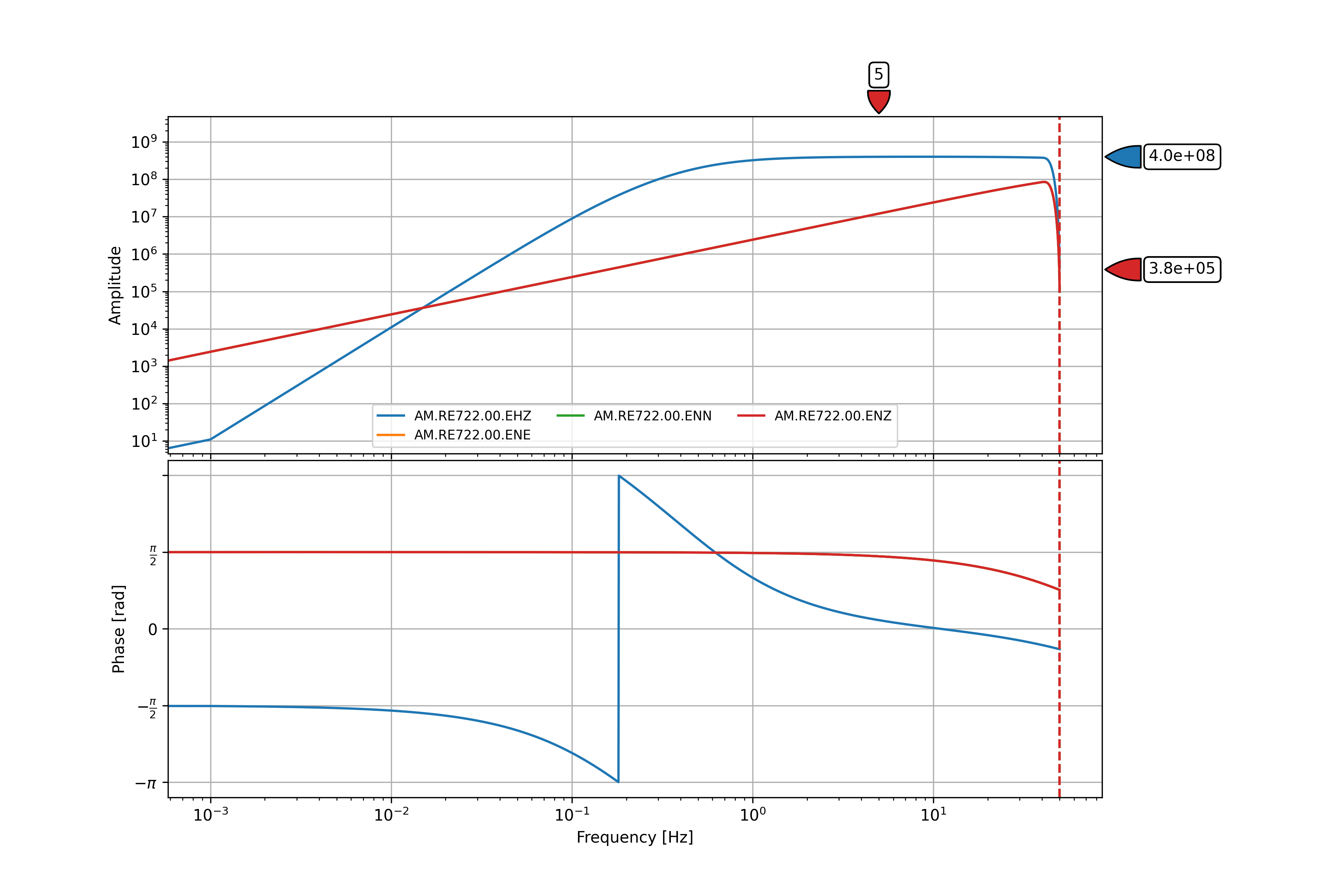 Sample instrument-response-file of RE722 station in PNG format.